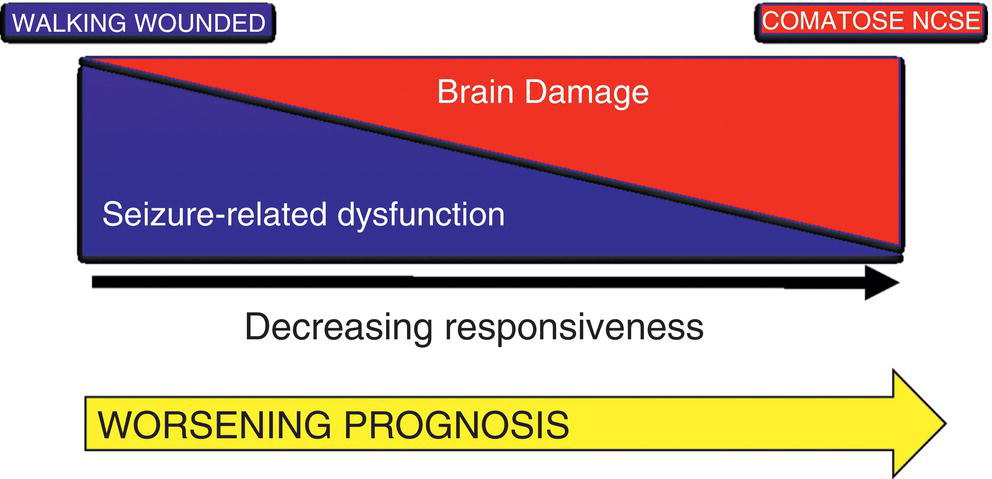
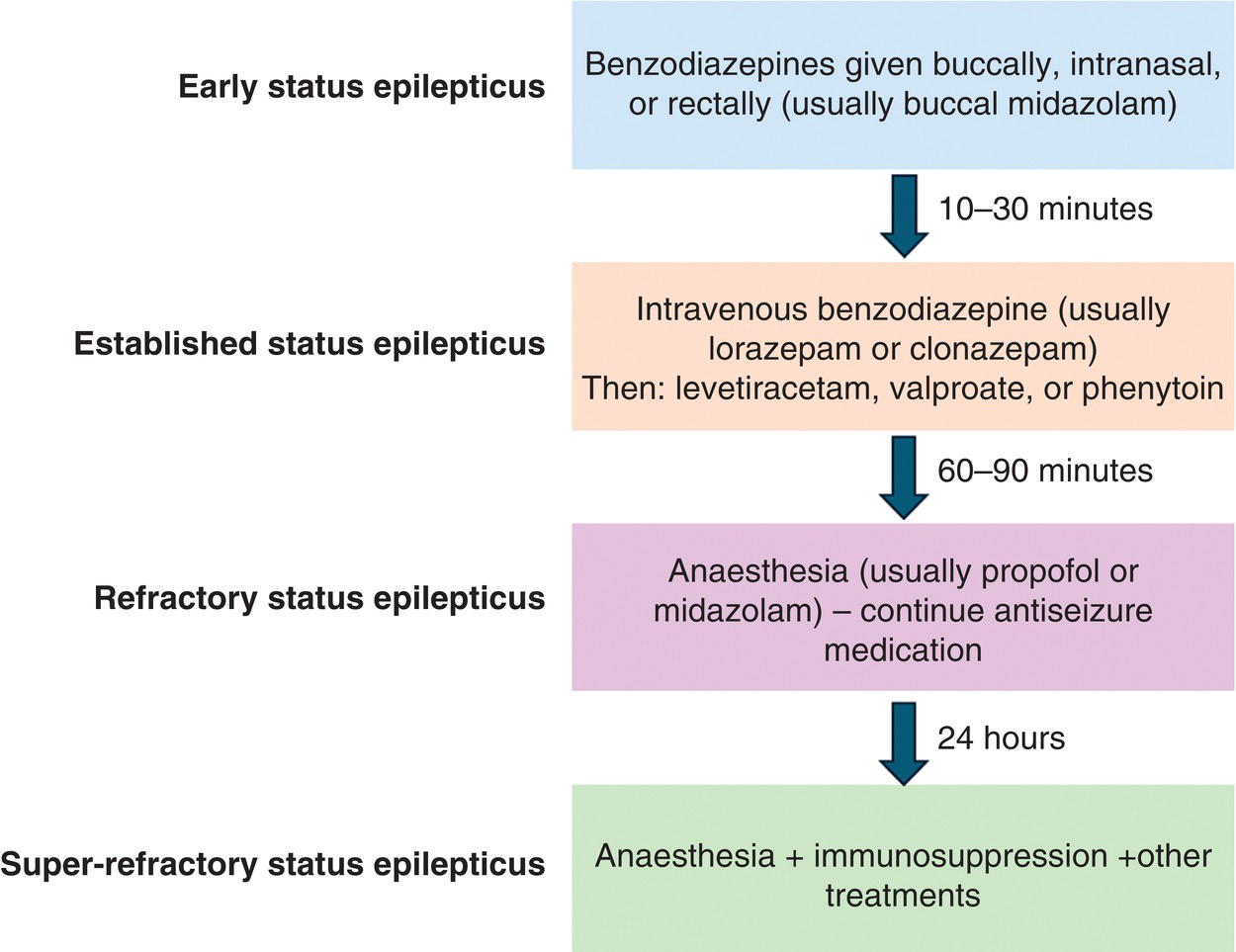
Matthew C. Walker Most seizures are self‐terminating, usually lasting less than two minutes. On occasion, however, they endure, leading to status epilepticus. About a third of adults attending an epilepsy centre have had an episode of status epilepticus, and over a fifth have had this recurrently.1 The definition of status epilepticus has changed over time. Initially, it was only applied to convulsive seizures – convulsive status epilepticus (CSE). The term status epilepticus is now used with all seizure types and is divided into status epilepticus with and without prominent motor signs/symptoms. A further concept that has evolved is how long a seizure must continue before being considered status epilepticus. Status epilepticus was defined as seizure activity that continued for at least 30 minutes, a time when irreversible neuronal damage can occur. However, seizures that continued beyond five minutes were often a criterion for instigating emergency treatment. Recognising this dichotomy, the new definition2 outlines status epilepticus as having two time points: ‘status epilepticus’ is a condition resulting either from the failure of the mechanisms responsible for seizure termination or from the initiation of mechanisms which lead to abnormally prolonged seizures (after time point t1). It is a condition that can have long‐term consequences (after time point t2), including neuronal death, neuronal injury, and alteration of neuronal networks, depending on the type and duration of seizures.’ t1 and t2 vary on the form of status epilepticus (Table 14.1). There have been several incidence estimates of mostly CSE, using the 30‐minute time criterion, ranging from 10 to 60 per 100,000 person‐years, depending on the characteristics of the population assessed. Incidence is higher in poorer settings.3 More than half of CSE occur in people without a prior history of epilepsy, ie de novo status epilepticus. Usually, the cause of the status epilepticus is evident from history and imaging. The common causes of de novo status epilepticus are acute cerebral anoxia (causing myoclonic status epilepticus in a coma), alcohol use, cerebral tumour, cerebral infection (especially encephalitis), stroke, head injury, fever (febrile status epilepticus in children), drugs, toxins or metabolic disorders.4 If there is a history of epilepsy, status epilepticus is often triggered by reduction or withdrawal of antiseizure medication (ASM) or intercurrent illness. If the cause is not immediately apparent, status epilepticus can result from uncommon conditions such as mitochondrial disease, autoimmune encephalitis, unusual infections, drugs, toxins or genetic disorders.5 Table 14.1 Approximate times in definition of status epilepticus. In some cases, no cause is found; in many such cases, unidentified autoimmune mechanisms are presumed to be at work. When new‐onset status epilepticus of unknown cause (not identified in the first 48 hours) is refractory to treatment, the acronym NORSE (new‐onset refractory status epilepticus) is often used. When NORSE is preceded by a prior febrile illness of unknown aetiology (up to two weeks), FIRES (febrile infection‐related epilepsy syndrome) can be used.6 These are not aetiologies but rather conditions with an unknown cause. About a quarter of people with status epilepticus die.7 The mortality rate is higher in those resistant to first‐and second‐line therapies. Neuronal damage, cognitive deficits, focal neurological deficits and epilepsy can also result from CSE, especially if prolonged and inadequately treated. Treating non‐convulsive status epilepticus (NCSE) depends on the subtype and the presentation.8 In typical absence status epilepticus, which responds well to oral or intravenous benzodiazepines, intensive emergency therapy is rarely needed. Treating focal NCSE is more challenging, and the outcome depends on the cause and degree of consciousness (Figure 14.1).9 Aggressive treatment with high doses of intravenous medication and anaesthesia can have significant adverse effects, which must be balanced against the potential benefits. If consciousness is relatively well retained, NCSE has a good prognosis and responds well to oral or intravenous benzodiazepines. In older adults, intravenous valproate or levetiracetam may be better tolerated. In contrast, people in a coma with NCSE have a poor prognosis, and aggressive treatment, following the protocol for CSE, is needed. About 5% of people in a coma following acute brain injury without overt clinical seizure activity are in NCSE.10 Treatment of rhythmic and periodic EEG patterns, which are often reported as NCSE, in comatose cardiac arrest survivors has no impact on prognosis.11 FIGURE 14.1 Outcomes of NCSE depend on the degree of consciousness, which may relate to underlying brain damage. Source: Adapted from Bauer and Trinka.9 If CSE persists, there is a substantial risk of seizure‐induced cerebral damage.12 The risk of mortality increases with the more prolonged seizures. There is also growing evidence that progressive treatment resistance develops over time, as CSE continues, due to alterations in receptors and receptor function.13 For these reasons, the drug treatment should be considered in stages (Figure 14.2). Status epilepticus may be preceded by a premonitory stage characterised by a crescendo of seizure activity, ie increasing seizure frequency or repetitive seizures without complete recovery between them.14 Treatment with benzodiazepines at this stage is often effective in preventing progression into full status. The treatment of choice is buccal midazolam, but other routes, including rectal, intranasal and intramuscular routes, can also be used to administer benzodiazepines. FIGURE 14.2 There should be a staged approach to the treatment of status epilepticus. The early stages are much more likely to respond to treatment than the later stages, which should thus be treated more aggressively. Failure to respond to a first‐ and second‐line treatment marks the progression into refractory status epilepticus. Prolonged seizures usually occur in the community in those with a diagnosis of epilepsy and so can be treated by carers, partners or relatives. People with epilepsy who have had or are at risk of crescendo seizures, clusters or status epilepticus should have a rescue plan for acute seizure treatment. This is usually a benzodiazepine given orally, intranasally, buccally or rectally, depending on circumstances. There is overwhelming data to support using benzodiazepines in the community for repeated and prolonged seizures.15 Those administering these treatments should receive appropriate instruction. Paramedics should also give acute seizure treatments. Intramuscular midazolam and intravenous lorazepam are also safe and effective, with intramuscular midazolam being easier and faster to administer.16 Since CSE results in respiratory compromise, the risks of benzodiazepines on respiration are mitigated by their ability to stop status epilepticus. Once status epilepticus continues for more than 10‐20 minutes, intravenous therapy is required, especially if initial benzodiazepines have not been effective. Intramuscular midazolam should be considered if intravenous access is delayed or difficult. Intravenous benzodiazepines, preferably lorazepam or clonazepam due to their favourable pharmacokinetics with longer redistribution half‐lives, are the initial treatments of choice. At this stage, systemic factors must be taken into consideration.17 Blood should be measured for electrolytes, glucose, full blood count, calcium and magnesium levels. Intravenous fluids should be administered, and glucose given if hypoglycaemia is suspected. Thiamine should be given to people suspected of malnutrition or alcohol abuse. Status epilepticus results in respiratory depression, and oxygen should be administered. If intravenous benzodiazepines are not entirely effective, loading with another intravenous agent is usually required. Traditionally, this has been 18mg/kg of phenytoin as a loading dose, or an equivalent fosphenytoin dose. Valproate 40mg/kg, with a maximum dose of 3000mg, or levetiracetam 60mg/kg, with a maximum dose of 4500 mg, are equally effective.18 They are becoming the preferred second‐line treatments, as both are easier to administer than is phenytoin. If CSE has not responded to a benzodiazepine and second‐line therapy, physiological compromise develops, leading to potential neuronal damage and increasing drug resistance. At this stage, the person should be transferred to intensive care and given an anaesthetic (propofol, thiopentone/pentobarbital or midazolam) to reduce electrographic activity, the cause of cerebral damage.19 ASM should be continued, aiming for the maximum safe dose and plasma levels. Ideally, continuous EEG monitoring should be instigated as seizure activity can be present with no or few clinical signs, such as hippus, nystagmus, changes in heart rate and blood pressure. Anaesthesia titration should be guided by EEG.20 Apart from treating CSE, it is necessary to address the cause. Refractory status epilepticus has different causes from drug‐responsive status epilepticus; in particular, encephalitis is more frequent, and a prior history of epilepsy is less frequent. Antiviral therapies, particularly acyclovir, are well‐established for treating suspected viral encephalitis. The use of corticosteroids is controversial. Steroids have been recommended in cases of acute viral encephalitis if there is evidence of progressive cerebral oedema. Autoimmune encephalitis, due to NMDA receptor antibodies, has increasingly been recognised as a cause of refractory status epilepticus.21 This may underlie cases of NORSE and may respond to immunosuppressive therapy, including high‐dose methylprednisolone, intravenous immunoglobulin, and/or plasma exchange. Super‐refractory status epilepticus is defined as status continuing for more than 24 hours after the start of anaesthetic therapy.22 General anaesthesia with EEG monitoring remains the mainstay of treatment in super‐refractory status epilepticus. The three anaesthetic drugs most commonly used are propofol, midazolam and thiopentone/pentobarbital. Ketamine is a second‐line drug because of the limited clinical evidence base. It is usual to reverse anaesthesia every 24–48 hours initially, and if seizures continue, then to re‐establish it for another 24‐48 hours. Regular ASM should always be given so that when the anaesthetic agent is withdrawn, there is adequate treatment cover. The choice of drug is somewhat arbitrary, but one or two drugs in high doses should be given, and switches should be avoided. When possible, drugs with low interaction potential, predictable kinetics, low allergenic potential and no renal or hepatic toxicity should be used. Hypothermia, magnesium infusion, pyridoxine infusion, and immunological therapy with steroids and/or IVIg or plasma exchange should be considered. Other treatments have been tried if the seizures continue, including using a ketogenic diet (not advisable in combination with propofol anaesthesia), electroconvulsive therapy or emergency neurosurgery if there is an identifiable focus. More recently, aggressive immunotherapy has been reported to be effective in cases of NORSE and FIRES. Attention also needs to be directed towards complications of status epilepticus and treatments.
CHAPTER 14
Status Epilepticus
STATUS EPILEPTICUS: DEFINITIONS AND CAUSES
Type of SE
Time (t1): seizures unlikely to stop
Time (t2): long term consequences
Tonic–clonic SE
5 min
30 min
Focal SE with impaired consciousness
10 min
>60 min
Absence status epilepticus
10–15 min
Unknown
MANAGEMENT OF STATUS EPILEPTICUS
TREATMENT OF NON‐CONVULSIVE STATUS EPILEPTICUS
TREATMENT OF CONVULSIVE STATUS EPILEPTICUS
Stage of early status epilepticus
Stage of established status epilepticus
Stage of refractory status epilepticus
Stage of super‐refractory status epilepticus
Related posts:



Stay updated, free articles. Join our Telegram channel

Full access? Get Clinical Tree


